
 English
 Español
 Deutsch
 русский
Thermal management is one of the single most decisive factors in determining how long industrial machinery die casting components remain serviceable. Components that experience uncontrolled thermal cycling, inadequate heat dissipation, or excessive operating temperatures fail significantly earlier — often 40–60% sooner than thermally optimized equivalents made from identical alloys. From die design through in-service thermal load management, every stage of a component's lifecycle is shaped by how heat is generated, transferred, and controlled.
Why Heat Is the Primary Enemy of Die Casting Component Longevity
Industrial machinery die castings — gearbox housings, motor end shields, hydraulic manifolds, compressor bodies — are subjected to continuous or cyclic thermal loads during operation. Heat degrades these components through several concurrent mechanisms:
- Thermal fatigue: Repeated expansion and contraction cycles introduce micro-cracks at stress concentration points — typically corners, thin walls, and threaded bosses. In aluminum A380 alloy components, thermal fatigue cracks initiate after approximately 10,000–20,000 cycles at ΔT of 150°C without mitigation.
- Creep deformation: At sustained temperatures above 150°C for aluminum alloys or 200°C for zinc alloys, die castings begin to deform plastically under load even below their yield strength, causing dimensional drift and loss of clamping force in bolted assemblies.
- Oxidation and corrosion acceleration: Elevated temperature increases the rate of electrochemical corrosion by a factor of 2–3× per 10°C rise (Arrhenius relationship), accelerating surface degradation and seal-face deterioration.
- Microstructural coarsening: Prolonged exposure to elevated temperatures causes grain growth and precipitate coarsening in aluminum alloys, reducing hardness and fatigue strength by up to 25% after 1,000 hours at 200°C.
Thermal Loads During the Die Casting Process Itself
Thermal management begins before the component enters service — it starts at the moment molten metal contacts the die. The thermal history imprinted during casting directly determines the component's residual stress state and microstructural quality, both of which govern long-term durability.
Die Temperature Control
In high-pressure die casting (HPDC), molten aluminum is injected at 620–680°C into dies maintained at 180–250°C for aluminum alloys. This controlled differential drives rapid, uniform solidification. Deviation from this window has direct consequences:
- Die temperature below 150°C: Premature solidification produces cold shuts and misruns, creating internal discontinuities that act as fatigue crack initiation sites.
- Die temperature above 280°C: Slow solidification promotes shrinkage porosity and coarse grain structure, reducing fatigue life by 30–40%.
- Temperature gradient across the die face greater than 80°C causes non-uniform solidification — parts of the casting solidify faster, introducing residual tensile stresses that reduce effective fatigue strength.
Cooling Channel Design in Dies
Conformal cooling channels — manufactured via additive tooling — follow the die cavity contour at a uniform offset of 8–12 mm, compared to straight-drilled channels that can be 25–40 mm from the cavity surface. Conformal cooling reduces cycle time by 15–25% and, critically, reduces thermal gradient across the part cross-section by up to 60%, directly improving microstructural uniformity and fatigue life of the finished component.
Alloy Selection Based on Thermal Performance Requirements
Not all die casting alloys respond equally to thermal stress. Selecting the right alloy for the operating temperature envelope is one of the most impactful thermal management decisions made at the design stage.
| Alloy | Max Continuous Service Temp. | Thermal Conductivity (W/m·K) | CTE (µm/m·°C) | Best Application |
|---|---|---|---|---|
| A380 Aluminum | 150°C | 96 | 21.8 | General machinery housings |
| A413 Aluminum | 170°C | 121 | 20.0 | Heat exchangers, thermal-critical components |
| Zamak 5 Zinc | 100°C | 109 | 27.4 | Precision parts in low-temp environments |
| AZ91D Magnesium | 120°C | 51 | 26.0 | Lightweight structural components |
| AM-HP2+ Mg (advanced) | 175°C | 62 | 24.5 | High-temp powertrain and robotics |
A413 aluminum's thermal conductivity of 121 W/m·K — 26% higher than A380 — makes it the preferred choice for components that must actively conduct heat away from critical zones, such as motor housings and hydraulic valve bodies in high-duty-cycle machinery.
Design-Stage Thermal Management Strategies
The geometry of the die casting itself is a thermal management tool. Design decisions made at the CAD stage determine how efficiently heat moves through and out of the component during operation.
Wall Thickness Optimization
Uniform wall thickness — ideally 2.5–4 mm for aluminum HPDC — promotes even heat distribution and minimizes hot spots. Abrupt thickness transitions create thermal stress concentrations: a step from 3 mm to 8 mm wall thickness generates a stress concentration factor (Kt) of approximately 1.8–2.2 at the transition, significantly accelerating fatigue crack initiation under thermal cycling.
Integrated Fin and Rib Structures
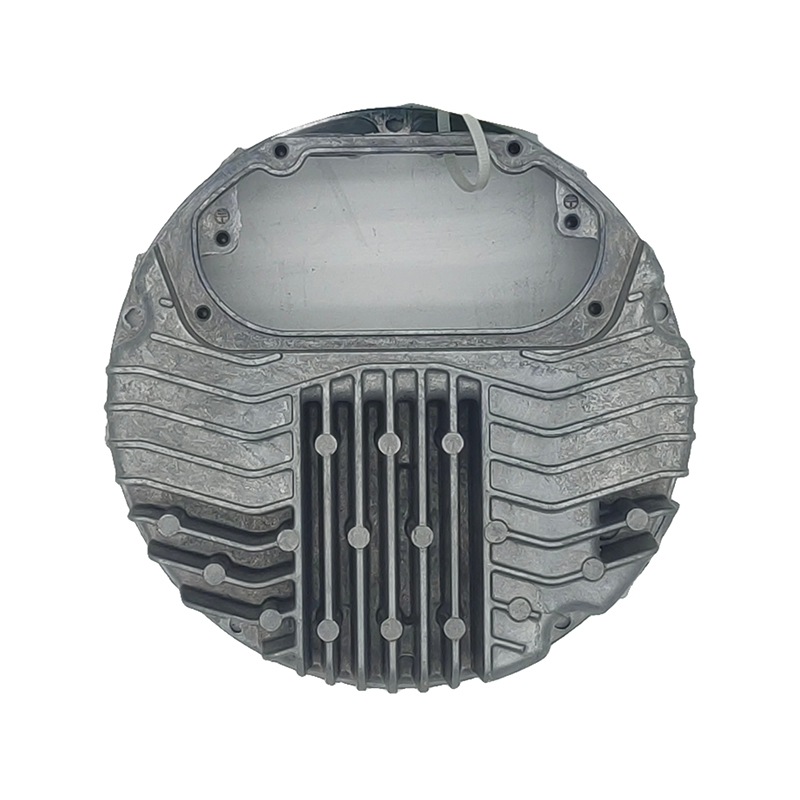
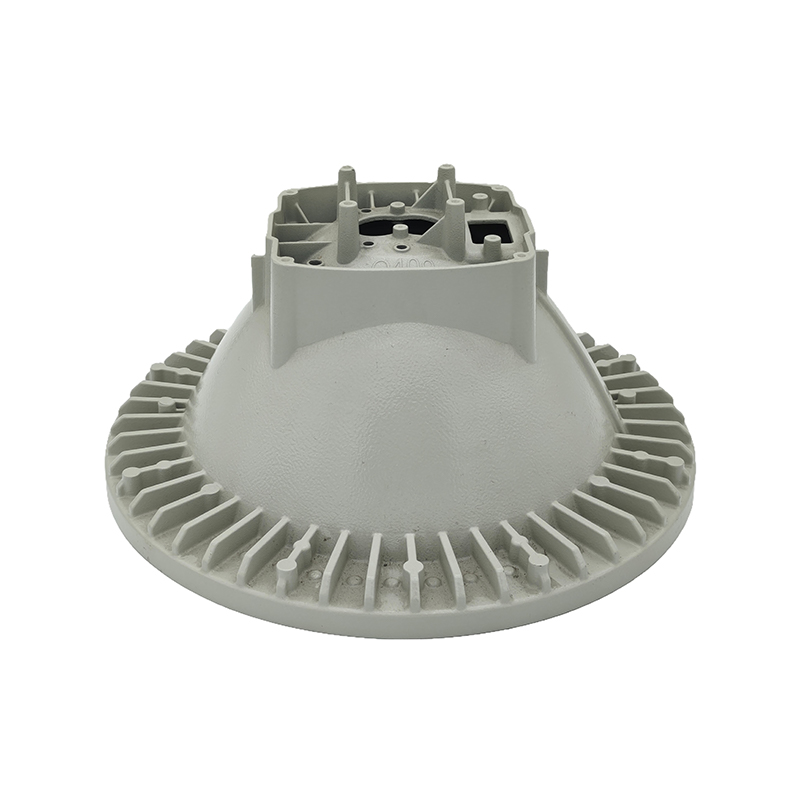
Die cast fins increase surface area for convective heat dissipation without adding bulk. A well-designed fin array on an aluminum motor housing can reduce steady-state operating temperature by 25–40°C at rated power output. Design rules for thermal fins in die casting:
- Fin height-to-thickness ratio: maximum 5:1 to ensure complete die fill and avoid cold-fill defects.
- Fin pitch: 4–8 mm for natural convection; closer spacing (2–3 mm) only beneficial with forced air cooling.
- Draft angle: minimum 1.5° per side on fin faces to allow ejection without tearing.
Cast-In Cooling Passages
For high-heat-load industrial components, steel or copper tubes can be encapsulated within the die casting during the shot process. This technique — used in hydraulic manifold blocks and high-power inverter housings — delivers liquid cooling directly to the heat source with thermal resistance up to 4× lower than surface-only cooling approaches.
Thermal Barrier and Surface Coatings for Extended Life
Surface treatments applied post-casting provide a thermal management layer that protects the base alloy from peak temperature excursions and oxidative degradation.
- Hard Anodizing (Type III, per MIL-A-8625): Produces an aluminum oxide layer 25–75 µm thick. This layer has very low thermal conductivity (~20 W/m·K vs. 96 W/m·K for A380), acting as a surface insulator that protects the substrate from transient heat spikes. Extends component life in cyclic-temperature environments by up to 2×.
- Thermal Spray Coatings (HVOF / Plasma Spray): Ceramic coatings (ZrO₂-Y₂O₃) deposited at 150–300 µm thickness reduce surface temperature by 100–200°C for components operating in direct flame or radiant heat environments. Used in die casting components in foundry machinery, furnace auxiliaries, and engine test equipment.
- Electroless Nickel + PTFE Composite Coating: Provides both thermal resistance and dry lubrication, reducing friction-generated heat at sliding interfaces. Service temperature up to 290°C continuous.
- High-emissivity Paints and Coatings: Increase radiative heat dissipation from housing surfaces. A black anodized or ceramic-coated aluminum surface achieves emissivity of ε = 0.85–0.95 vs. bare aluminum at ε = 0.05–0.10, dramatically improving passive cooling in enclosed machinery cavities.
Thermal Simulation and Validation Before Production
Modern die casting development integrates thermal simulation at the design stage to predict component behavior before tooling is cut — avoiding costly late-stage design revisions.
Key Simulation Tools and Their Role
- Casting Process Simulation (MAGMASOFT, ProCAST): Models melt flow, solidification, and thermal gradient during the casting shot. Identifies hot spots, shrinkage zones, and residual stress fields before die fabrication. Reduces tooling rework costs by 30–50% in complex industrial components.
- FEA Thermal-Structural Analysis (ANSYS, Abaqus): Simulates in-service thermal cycling, calculates component life using Coffin-Manson fatigue models, and identifies geometry modifications to extend predicted life. A typical optimization cycle reduces peak thermal stress by 15–30% through geometry refinement alone.
- Computational Fluid Dynamics (CFD — Fluent, OpenFOAM): Models heat transfer from component surfaces to surrounding air or coolant. Validates fin array designs and cooling passage layouts against thermal performance targets before physical prototyping.
Physical validation follows simulation: thermographic imaging (infrared cameras with sensitivity of ±0.1°C) maps actual surface temperature distributions during accelerated thermal cycling tests, confirming simulation accuracy and identifying unexpected hot spots.
In-Service Thermal Management: System-Level Considerations
Even the best-designed die cast component will degrade prematurely if the surrounding system fails to manage heat loads adequately. System-level thermal management is as important as component-level design.
| Thermal Management Method | Typical Temp. Reduction | Life Extension Benefit | Common Application |
|---|---|---|---|
| Forced air cooling (fan) | 20–40°C | 1.5–2× | Motor housings, gearboxes |
| Liquid cooling jacket | 60–120°C | 3–5× | High-power inverters, hydraulic manifolds |
| Heat pipe integration | 40–80°C | 2–3× | Electronics housings, sensor assemblies |
| Phase change material (PCM) buffers | 30–60°C peak | 1.5–2.5× for cyclic loads | Intermittent-duty machinery |
The Arrhenius rule of thumb for electronic and mechanical components — that every 10°C reduction in operating temperature approximately doubles service life — applies meaningfully to aluminum die castings operating in their creep and oxidation temperature range (130–200°C). A liquid cooling system that reduces housing temperature from 160°C to 130°C can therefore theoretically extend component life by a factor of ~8× for thermally-driven failure modes.
Predictive Maintenance and Thermal Monitoring in Operation
Embedding thermal sensors within or adjacent to critical die casting components enables real-time life consumption monitoring — shifting maintenance from time-based schedules to condition-based intervention.
- Thermocouple and RTD Integration: Type K thermocouples or PT100 RTDs mounted in drilled pockets within the die casting provide ±0.5°C accuracy for continuous thermal profiling. Data feeds into SCADA/PLC systems with alarm thresholds set at 85% of maximum rated component temperature.
- Thermal Cycling Count Tracking: Modern IIoT platforms log the number and amplitude of thermal cycles, feeding into Coffin-Manson damage accumulation models. This allows remaining fatigue life to be estimated with ±15% accuracy, preventing both early replacement waste and unexpected failures.
- Infrared Thermography Surveys: Periodic IR camera surveys during operation identify abnormal hot spots (temperature deviations >15°C above baseline) indicating developing defects — porosity-induced thermal bridges, cracked sections, or degraded thermal interfaces — before catastrophic failure occurs.
Plants implementing condition-based thermal monitoring on critical die casting components report unplanned downtime reductions of 35–55% and component replacement cost savings of 20–30% compared to fixed-interval replacement schedules, according to industry maintenance benchmarking data.


 1 Building No.1 No.226. Tiantaishan Road, Daqi street. Beilun District, Ningbo City, Zhejiang Province, China
 +86-15967858563
